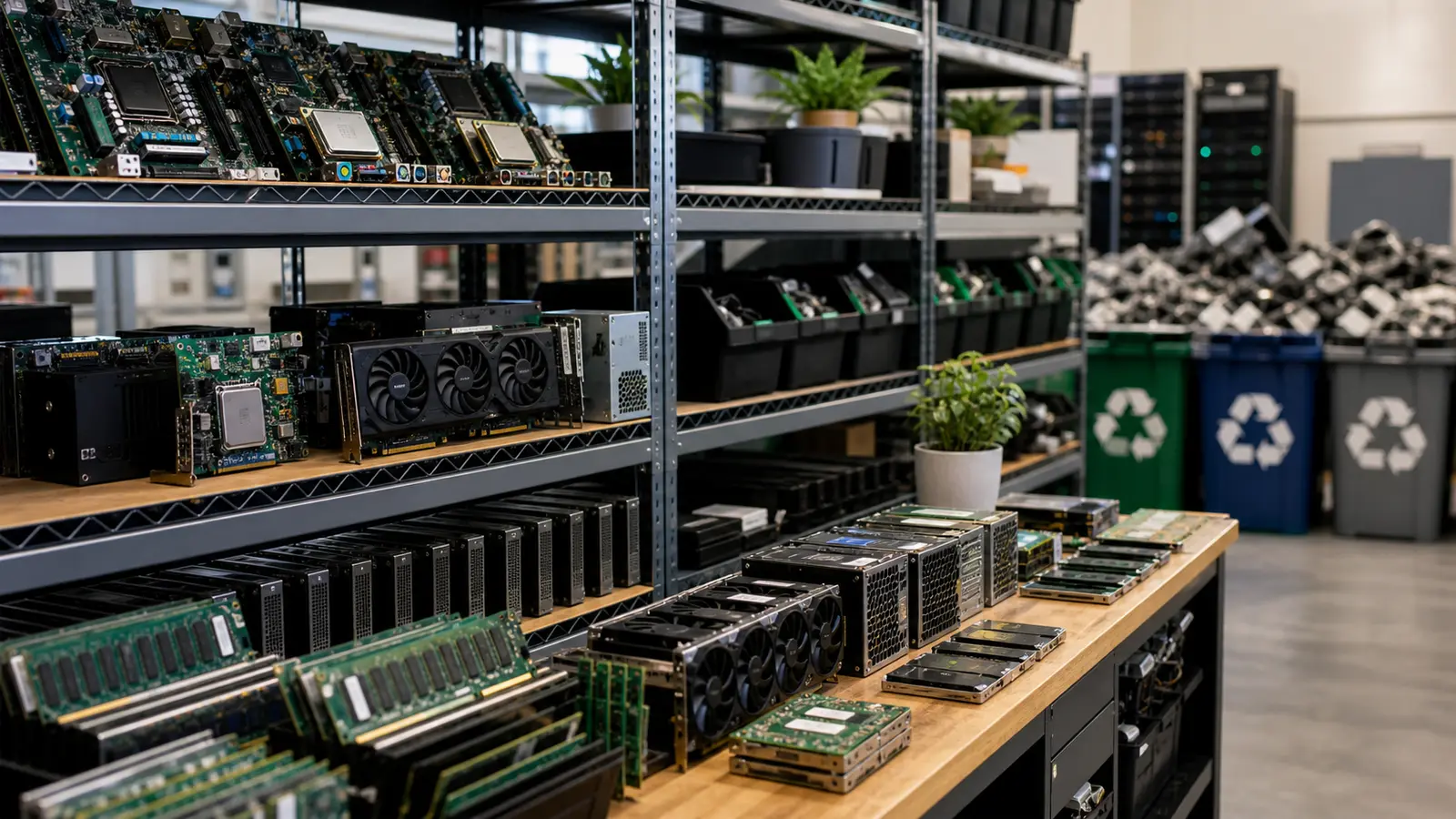
Recycling is important, but it is not always the first best step for old IT equipment. Many computers, servers and components still have useful life even after they no longer fit the original owner’s needs. A business may replace workstations for performance, standardization or warranty reasons, while the hardware still contains usable RAM, CPUs, power supplies, network cards, rails, fans, cases, screens or accessories. Recovering that value before recycling can reduce waste and lower the demand for unnecessary new parts.
Silicon Rescue follows a simple principle: physically destroy drives first, reuse non-storage components that can still work, and recycle what cannot be responsibly reused. This is different from treating every retired asset as generic scrap. It is more careful, more useful and usually better aligned with the real environmental goal.
Why reuse usually beats immediate recycling
Manufacturing technology has a high material and energy cost. Metals must be mined, refined, transported and assembled. Semiconductors, circuit boards and power components require complex supply chains. When a working component is reused, the environmental value is not only the material recovered from recycling. It is the avoided impact of producing a replacement part too soon.
Immediate recycling still has a role, especially for damaged, unsafe or obsolete material. But when a part can be tested and redeployed, reuse extends the life of the original manufacturing investment. For repair shops, labs, small businesses and budget-conscious buyers, recovered components can be a practical alternative to buying new.
What non-storage equipment is often recoverable
- Business desktops, small form-factor PCs and workstations.
- Servers, rails, redundant power supplies, fans and non-storage modules.
- RAM, CPUs, GPUs, network cards and expansion cards.
- Network switches, routers, access points and related power adapters.
- Monitors, docks, keyboards, cables and other useful accessories.
Not every item should be reused. Some equipment is too damaged, too old, too inefficient or too costly to test. That is why intake matters. A responsible recovery process sorts equipment by likely reuse value, data risk and recycling path.
Data handling comes first
Reuse should never create privacy risk. Hard drives, SSDs and storage media must be identified and physically destroyed before equipment is resold, donated, parted out or recycled. Silicon Rescue does not reuse customer storage devices; reuse applies to the remaining non-storage equipment and components.
This order is important: do not start with value recovery and then think about data later. Start by destroying drives, then decide which non-storage components can be recovered.
How reuse supports a better circular workflow
A circular workflow keeps useful equipment in service longer. It does not mean keeping everything forever or pretending old hardware is always valuable. It means making a deliberate decision. If a non-storage server part can keep another system running, it should not be destroyed as a first move. If a workstation can be used for parts, it should be sorted instead of discarded. If material cannot be used, it should go to a responsible recycling stream.
For the owner of unused equipment, the practical step is simple: do not throw everything into the same pile. Send an equipment list, include photos, and identify any assets that may contain data. Silicon Rescue can help determine which storage devices must be destroyed and which non-storage components can be reused, recovered or recycled.
The better outcome
The best IT retirement plan is not just about disposal. It is about protecting information, reducing unnecessary waste and recovering practical value. Reuse before recycling is not a slogan; it is a workflow. When done correctly, it gives unused equipment a responsible next step without treating every asset like trash.
The difference between reuse, resale and recycling
Reuse means an item or component can continue doing useful work. Resale is one possible reuse path, but it is not the only one. Parts may be used for repairs, testing, donation, labs, internal replacements or training. Recycling means the item is broken down for material recovery. Both reuse and recycling can be responsible, but they should not be treated as the same thing.
When everything is sent directly to recycling, useful parts can be lost too early. When everything is pushed toward resale without proper testing or data handling, the process can create risk. The better workflow is selective: identify what can be safely reused, then recycle the rest.
How to decide what is worth recovering
Recovery value depends on condition, compatibility, demand and handling cost. A newer business workstation may be useful as a complete system. An older server may be more useful as parts. A broken laptop may still contain a working screen, RAM or charger. Networking equipment may be valuable if it is still supported, but less useful if it is locked, damaged or missing power supplies.
The decision should also include time. If testing a part costs more effort than the part is worth, recycling may be more responsible. Reuse-before-recycling is not about saving every object. It is about avoiding careless destruction of equipment that still has practical value.
Environmental value comes from extending life
Many sustainability conversations focus only on recycling rates. That misses an important point: the cleanest material is often the material that does not need to be newly manufactured yet. Extending the service life of a component can reduce demand for replacement production, packaging and shipping. For buyers, a recovered component may solve a real problem at lower cost. For sellers, it keeps equipment from becoming waste too early.
This is why Silicon Rescue’s message is not “throw us your electronics.” The message is more specific: send the equipment you no longer use so it can be reviewed, secured, reused where possible and recycled responsibly where reuse is not practical.
What owners should do before disposal
Before clearing a storage room, group items by type and separate obvious storage media. Take photos, count approximate quantities and note whether the equipment was recently working. That simple preparation helps recover more value and reduces the chance that reusable assets are lost in a mixed scrap stream.
A better retirement process is not complicated. It is intentional. Drives destroyed first, non-storage reuse second, recycling third.